

Recent Research: Why Recognition Alone Isnt Driving Engagement and What Actually Works
.png) New research on Generation Z productivity offers a timely and important insight for organizational leaders: incentives alone do not drive productivity — appreciation and loyalty do. While most organizations continue to invest heavily in structured recognition and reward programs, engagement continues to decline and retention remains HR’s top concern at many organizations. The findings of this study suggest the issue may not be recognition itself, but how it is being used.
New research on Generation Z productivity offers a timely and important insight for organizational leaders: incentives alone do not drive productivity — appreciation and loyalty do. While most organizations continue to invest heavily in structured recognition and reward programs, engagement continues to decline and retention remains HR’s top concern at many organizations. The findings of this study suggest the issue may not be recognition itself, but how it is being used.What the Research Shows — and Why It Matters
Personalization Is Essential
Click here to subscribe to RRN weekly, and here for an RRN media kit.
A recent study conducted in Indonesia found that incentives had no significant direct effect on productivity, while appreciation had a strong positive impact. Both incentives and appreciation strengthened loyalty — and loyalty significantly increased productivity. In other words, loyalty mediates performance outcomes, and appreciation is a key driver of loyalty, the researchers find.
 For insights on this study, ESM interviewed Dr. Paul White, Founder and President Emeritus of Appreciation at Work, an advisory, training, and certification firm focused specifically on how to make appreciation the foundation for a successful culture.
The research he believes has major implications. Despite over 90% of companies implementing structured employee recognition programs, employee engagement continues to fall. “What we are doing isn’t working,” he observes. “The research suggests that transactional reward systems may validate performance, but they do not necessarily build the emotional commitment required for sustained engagement and retention.”
To White, this research confirms critical truths:
- Incentives alone do not drive productivity.
- Appreciation directly increases performance.
- Loyalty is the bridge between acknowledgment and results.
- Recognition and appreciation must work together.
The research, titled “The Effect of Incentives and Appreciation on Generation Z Productivity with Loyalty as a Mediating Variable: A Case Study in Surakarta City,” was conducted by Aqilla Fadya Haya Hakim and Irmawati of Universitas Muhammadiyah Surakarta, Indonesia.
The study surveyed 132 Generation Z employees (born 1997–2012) working in Surakarta City. Using a quantitative approach and Structural Equation Modeling (SEM-PLS) analysis via SmartPLS 4, the researchers tested direct and indirect relationships between incentives, appreciation, loyalty, and productivity. Statistical testing confirmed significant paths between appreciation and productivity, and between loyalty and productivity, while incentives alone did not directly predict higher output.
What the Research Shows — and Why It Matters
Incentives Alone Do Not Drive Productivity. One of the most striking findings is that incentives — financial or material rewards beyond salary — did not significantly increase productivity on their own. This reinforces White’s long-standing concern about modern recognition programs.
Organizations, he notes, have invested heavily in points systems, bonuses, and structured awards, assuming these would increase engagement and retention. Yet engagement scores continue to decline, and turnover remains a persistent challenge. This does not mean incentives are useless. Rather, it suggests they are incomplete. Incentives may influence short-term behavior, but they do not necessarily cultivate deeper commitment.
Appreciation Has a Direct and Powerful Impact. In contrast, appreciation — non-material acknowledgment such as praise, feedback, and expressions of value — had a strong positive effect on productivity, the study finds. Here is where White’s distinction becomes critical. Recognition typically focuses on performance and achievement. Appreciation focuses on the individual — communicating that the person is valued, not just their output. Appreciation, he explains:
- Fulfills psychological and relational needs
- Strengthens intrinsic motivation
- Reinforces belonging and identity
- Encourages discretionary effort
Loyalty Is the Critical Link. Perhaps the most important finding, White feels, is that loyalty mediates the relationship between incentives, appreciation, and productivity. Both incentives and appreciation increased loyalty, and loyalty significantly increased productivity. This insight reframes the entire discussion.
Productivity is not simply about motivating effort, he adds. It is about fostering commitment. Loyalty reflects emotional attachment, alignment with organizational values, and willingness to invest discretionary effort over time. White has consistently argued that recognition programs must move beyond validating contributions and toward building relational connection. The research supports this view: incentives only influenced productivity indirectly — through their ability to strengthen loyalty. Appreciation, however, had both direct and indirect effects.
Recognition Is Not the Problem — Incompleteness Is. It would be easy to conclude that recognition programs should be eliminated. But as White notes, that would be “throwing the baby out with the bath water.” Recognition and reward systems are deeply embedded in organizational culture and do serve important purposes:
- They validate contributions.
- They foster a sense of achievement.
- They reinforce desired behaviors.
- They encourage task completion.
The research suggests that sustainable engagement requires both.
Personalization Is Essential
A key recommendation from the study is that organizations must personalize and customize their approaches. One-size-fits-all systems fail to address the diverse needs of today’s workforce. White emphasizes that appreciation is not formulaic. It must be authentic and individualized. Different employees — and especially different generations — respond to different forms of acknowledgment.
Organizations that train leaders to express meaningful appreciation, rather than relying solely on structured reward platforms, are more likely to build loyalty and long-term engagement, the study suggests.
Enterprise Engagement Alliance Services
Celebrating our 15th year, the Enterprise Engagement Alliance helps organizations enhance performance through:
1. Information and marketing opportunities on stakeholder management and total rewards:
ESM Weekly on stakeholder management since 2009; click here for a media kit.
RRN Weekly on total rewards since 1996; click here for a EEA YouTube channel on enterprise engagement, human capital, and total rewards insights and how-to information since 2020.
2. Learning: Purpose Leadership and Stakeholder
 Management Academy to enhance future equity value and performance for your organization.
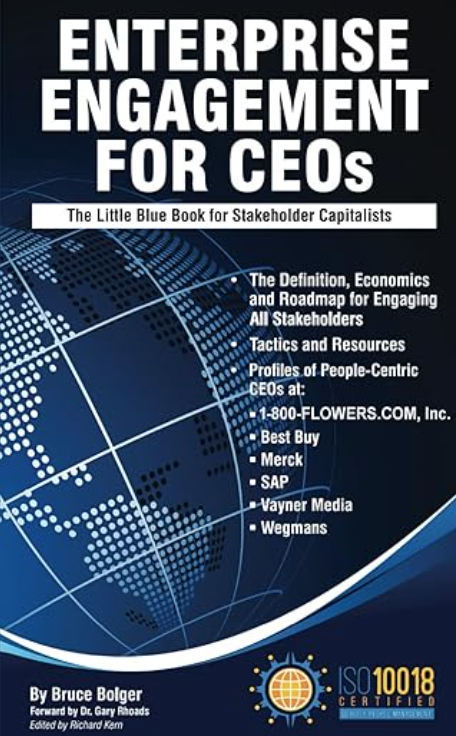
3. Books on implementation: Enterprise Engagement for CEOs and Enterprise Engagement: The Roadmap.
4. Advisory services and research: Strategic guidance, learning and certification on stakeholder management, measurement, metrics, and corporate sustainability reporting.
5. Permission-based targeted business development to identify and build relationships with the people most likely to buy.
6. Public speaking and meeting facilitation on stakeholder management. The world’s leading speakers on all aspects of stakeholder management across the enterprise.