

Meetings Are at a Breaking Point: Selective Audiences, Micro-Events, and the Demand for Measurable Purpose
 An Enterprise Engagement Alliance RRN roundtable makes the case that the meetings and motivational events industry is moving far too slowly to update formats as audiences become more selective, less tolerant of passive formats, and far more demanding about relevance, authenticity, and human connection.
The Matter Is Urgent: Event Attendance and Engagement Is on the Deline
The New Currency Is Time
The Gap Between Awareness and Execution Remains Large
A Broader Definition of ROI
A Fresh Approach to Formats
Yes, Purposeful Events Require New and More Thinking
Click here to subscribe to RRN weekly, and here for an RRN media kit.
The evidence is no longer anecdotal. Across trade shows, conventions, sales meetings, and incentive events, attendees are signaling that the old model is losing its hold: younger professionals are opting out of broad, generic gatherings in favor of smaller, more relevant “micro meetings”; organizers are seeing that time has become the ultimate filter for attendance and engagement; and even experienced event leaders admit that too many organizations still plan meetings on autopilot, without clear purpose, stakeholder alignment, or meaningful metrics.
These are some of the key findings from the latest Enterprise Engagement Alliance/Rewards Recognition Network (RNN) YouTube discussion on meaningful meetings.
Panelists are: Jaki Baskow, Principal of Las Vegas Speakers Bureau; Greg Bogue, Vice President of Experience at Maritz; Andrea Doyle, Executive Editor of Skift; Marc Matthews, Founder of Pulse Experiential Travel, Hillary Smith, Global Head, Creative and Marketing, Creative Group Inc.
Click here to watch and/or listen to the show to benefit from the full extent of their insights.
The Matter Is Urgent: Event Attendance and Engagement Is on the Deline
A sense of urgency among the panelists was the underlying tone of the discussion led by Bruce Bolger, founder of the Enterprise Engagement Alliance and publisher of
.png) RRN weekly. Bolger’s challenge to the panelists was direct: meetings remain one of the most powerful tools organizations have to move people, build trust, strengthen culture, and solve problems face to face, yet too many companies still treat them like commodities. Rather than approaching meetings as strategic assets with defined outcomes, stakeholder input, and impact measures, many organizations still default to last year’s agenda, last year’s format, and last year’s assumptions.
RRN weekly. Bolger’s challenge to the panelists was direct: meetings remain one of the most powerful tools organizations have to move people, build trust, strengthen culture, and solve problems face to face, yet too many companies still treat them like commodities. Rather than approaching meetings as strategic assets with defined outcomes, stakeholder input, and impact measures, many organizations still default to last year’s agenda, last year’s format, and last year’s assumptions.Andrea Doyle, Executive Editor of Skift Meetings, pointed to one of the clearest trend lines: the rise of the micro meeting. As younger generations enter the workforce, she says, they are becoming more discerning about where they spend their time. They do not want to attend every trade show, convention, or large-format gathering. They want focused events with relevant information, usable peer connections, and a clear reason to show up. Large umbrella events increasingly are being supplemented by smaller, more targeted gatherings because broad attendance can no longer be taken for granted.
That point was reinforced by Jaki Baskow, Principal of Las Vegas Talent Bureau, who says attendees now need a reason not only to come, but to stay. In her view, the market has moved well beyond the assumption that people will sit through a day of auditorium programming simply because a company or association scheduled it. Whether attendance is optional or mandatory, audiences are harder to hold, more protective of their time, and quicker to disengage if the content feels generic, stale, or disconnected from their needs.
The New Currency Is Time
Greg Bogue, Vice President of Experience for Maritz, brings perhaps the sharpest lens to the shift: time is now the currency of experience. If an event does not feel worth someone’s time, they will not attend, will not remain engaged, and will not follow the prescribed path organizers once assumed they would. He argues that what is unfolding is not just a programming challenge but a power shift. Attendees increasingly want control over how they spend their time, whom they meet, and how they engage. The old “group think” mindset is giving way to a far more individual mindset, and planners who fail to adapt risk losing the audience altogether.
Marc Matthews, CEO of Pulse Experiential Travel, speaking from the experiential travel perspective, echoes that generational change is not a cliché. Younger professionals, he says, want career-relevant access, memorable experiences, and meaningful opportunities to build relationships with senior leaders and peers. They do not want meetings built around information they could have found online or generated through AI. They want quality time, authentic interaction, and access that helps them develop professionally. That is a profound shift in expectations, and it has direct implications for how organizations should design meetings, he feels.
What makes the discussion especially notable was that none of the speakers suggested the industry lacks ideas. The frustration, instead, was that the application remains too limited and too slow. Doyle says she is seeing more interactivity and fewer 45-minute solo keynote sessions, with more panels, shorter formats, and more sponsor activations designed around audience participation. But she and others also make clear that true redesign remains the exception, not the rule. Too many events still preserve the same basic architecture: long blocks of passive listening, a thin layer of entertainment, and too little space for purposeful interaction.
The Gap Between Awareness and Execution Remains Large
That gap between awareness and execution was a major theme in Hillary Smith’s remarks. She argues that the biggest failure is not creativity, but process. Based in part on what she hears in the industry, many organizations still are not collaborating deeply enough on the front end. They are not bringing the right stakeholders together, not defining the real business problem the event is supposed to solve, not aligning brand, culture, and business outcomes, and not embedding measurement into design from the beginning. Strategy and design may finally be “having a moment,” she says, but many in the field still are not walking the walk at scale, she believes.
That insight cuts to the heart of the problem. For all the talk of innovation, too many meetings still are not designed like strategic business tools. They are designed like inherited rituals. The agenda is built first; the justification comes later. Speakers are selected because of status, familiarity, or executive preference rather than relevance to audience needs and event purpose. Measurement often is reduced to satisfaction surveys or simple ROI debates, rather than a broader continuum of impact that might include relevance, retention, connection, behavior change, preference, transformation, or business performance.
A Broader Definition of ROI
Bogue argues that the measurement issue needs to be broadened beyond the traditional return on investment in the event business because of their broad impact. Rather than fixating only on traditional ROI, organizations should think in terms of a measurement continuum, from cost management to strategic asset value. Events can be measured financially, he says, but they also can and should be measured for satisfaction, preference, time spent, engagement, repeat attendance, and transformation. What did people do or gain from their participation? If people are not coming back, that in itself is a metric, he underlines. If they are disengaging, walking out, or tuning out, that is a metric, too. The problem is not the absence of possible measures. It is the failure to align them with purpose from the start, he says.
Another striking insight comes from Doyle’s reference to research showing that only a tiny percentage of events assign someone responsibility for attendee connection, even though networking and peer interaction consistently rank among the top reasons people attend meetings. That disconnect is revealing. Organizations say people come to connect, but many events still are not intentionally designed to help that happen.
A Fresh Approach to Formats
Several practical ideas emerged during the discussion. Matthews describes trade show formats built around small-group business meetings combined with experiential activities designed to build relationships over several days. Baskow speaks about using talent not simply as performers but as facilitators of engagement and shared experiences. Doyle points to interactive formats that reinforce learning through participation. Smith emphasizes the importance of designing “micro moments” across the attendee journey—those often overlooked windows of time when meaningful connections can occur organically. Use meetings, she says, to solve problems, innovate new ideas, or otherwise address a key organizational priority by involving people, not just speaking to them.
The conversation also challenges lazy thinking about celebrity appearances and entertainment. High-profile speakers may attract attention, but attention alone does not create value. If the content is not relevant or interactive, organizations may simply be paying for a momentary spike in interest rather than lasting engagement. Doyle believes the best speakers are often thought leaders in the industry, not people who have no understanding of the field.
Another underused opportunity discussed was authentic community engagement. Rather than relying solely on traditional charitable activities, speakers describe the impact of giving attendees meaningful ways to interact with local communities in a way that supports the local economy and which can also include a contribution to local causes. When participants feel they are doing something meaningful, the experience becomes more memorable and authentic.
One of the most important themes to emerge was the growing importance of trust in an AI-driven world. As misinformation spreads and digital communication becomes less reliable, face-to-face interaction becomes even more valuable. People attend meetings to hear directly from credible sources and to build relationships they can trust.
Yes, Purposeful Events Require New and More Thinking
Yet perhaps the most uncomfortable takeaway from the discussion is that the biggest barrier to change may simply be the amount of thought required. Strategic meetings demand deeper research, stakeholder input, intentional design, and measurable outcomes, all of which AI can assist with. That is harder than assembling a standard agenda of keynote speakers, panels, and receptions. But as the panelists emphasized, the cost of failing to change may be far greater.
The meetings industry therefore faces a critical choice. It can continue making incremental tweaks to a format that is steadily losing its effectiveness, or it can treat meetings and motivational events as the strategic enterprise tools they are meant to be. That means defining purpose before agenda, designing for human connection rather than passive attendance, involving stakeholders in shaping the experience, and applying scientific discipline and meaningful metrics from the start.
The warning signs are already visible. The audience has already changed. The real question now is whether organizations will change with it or simply continue to bury the waste in their bottom lines.
Enterprise Engagement Alliance Services
Celebrating our 15th year, the Enterprise Engagement Alliance helps organizations enhance performance through:
1. Information and marketing opportunities on stakeholder management and total rewards:
ESM Weekly on stakeholder management since 2009; click here for a media kit.
RRN Weekly on total rewards since 1996; click here for a EEA YouTube channel on enterprise engagement, human capital, and total rewards insights and how-to information since 2020.
2. Learning: Purpose Leadership and Stakeholder
 Management Academy to enhance future equity value and performance for your organization.
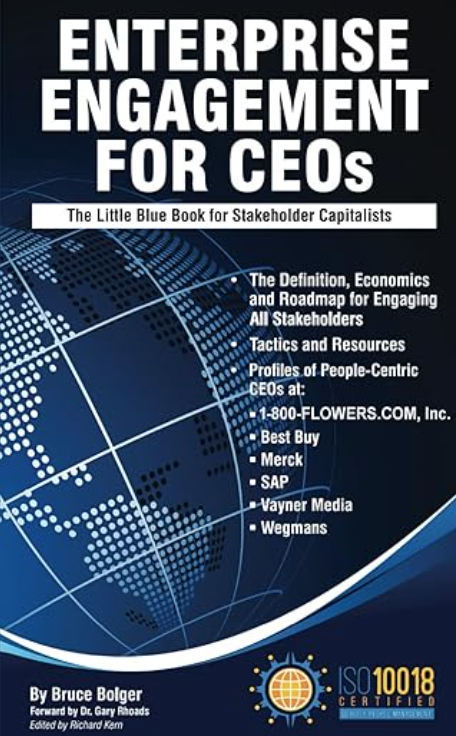
3. Books on implementation: Enterprise Engagement for CEOs and Enterprise Engagement: The Roadmap.
4. Advisory services and research: Strategic guidance, learning and certification on stakeholder management, measurement, metrics, and corporate sustainability reporting.
5. Permission-based targeted business development to identify and build relationships with the people most likely to buy.
6. Public speaking and meeting facilitation on stakeholder management. The world’s leading speakers on all aspects of stakeholder management across the enterprise.