

G2 Ratings Help Buyers Compare Engagement and Recognition Software—But Do They Measure Business Impact?
Two Related but Different Categories
What Determines a G2 Rating?
Does G2 Measure Results?
What G2 Does Not Appear to Measure
A Valuable Starting Point—Not the Final Answer
The Next Opportunity for the Industry
Click here to subscribe to the ESM weekly e-newsletter.
Organizations evaluating employee engagement and recognition technology can find an enormous amount of useful information on G2’s Employee Engagement Software and Employee Recognition Software pages. The platform helps buyers compare products based on verified user reviews, satisfaction, usability, support, adoption, features, and market presence. The important caveat for management is that G2 primarily measures how customers experience and use the software—not whether the technology has produced independently verified improvements in workforce or enterprise performance.
This epitomizes the state of recognition today: a focus on activity rather than performance metrics.
Two Related but Different Categories 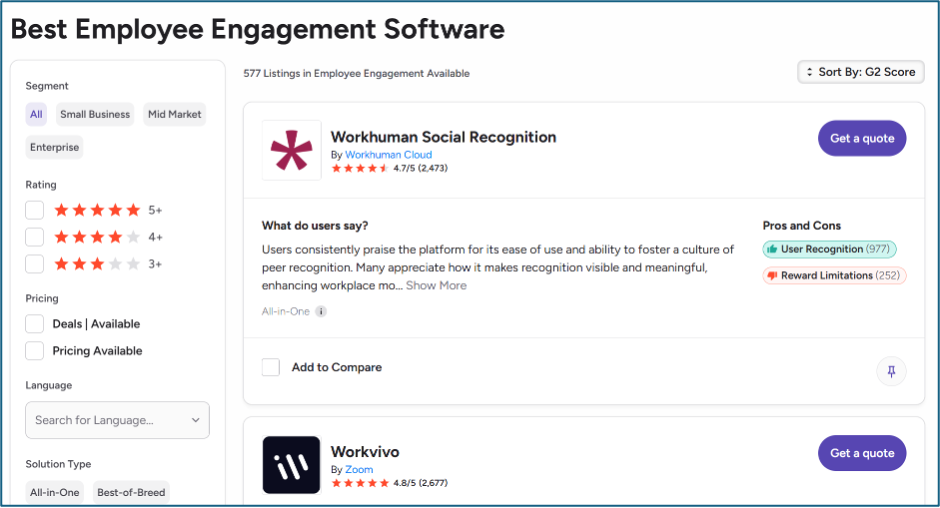
G2 treats employee recognition and employee engagement as related but distinct software categories. To qualify as employee recognition software, a product must enable rewards such as gift cards, tangible gifts, or recognition messages; provide a portal for managing recognition; and automate recurring recognition events or notifications. Common uses include peer-to-peer recognition, milestone awards, recognition tied to company values, and programs intended to support morale and retention.
Employee engagement software has a broader listening and feedback focus. To qualify, products must support employee pulse surveys, enable organizations to create and distribute customized surveys, organize survey data for reporting, and promote recognition through internal communications. G2 identifies common uses including measuring employee sentiment, supporting continuous feedback, and encouraging recognition across the organization.
The distinction is useful. Recognition software generally focuses on acknowledging contributions and delivering awards, while engagement software is more likely to include employee listening, surveys, feedback, analytics, and tools intended to help management act on workforce sentiment.
In practice, however, the lines are increasingly blurred. Many engagement platforms include recognition and rewards, while many recognition platforms promote themselves as broader employee engagement solutions.
What Determines a G2 Rating?
G2’s primary Grid rankings are based on two major factors: customer satisfaction and market presence, the company says. The satisfaction score considers user ratings of product attributes, satisfaction with administration, overall satisfaction, likelihood to recommend, the volume and quality of reviews, and the age of those reviews. More recent and more thoroughly completed reviews generally receive greater weight.
Market presence reflects the size, visibility, growth, and reach of the software product and its provider. G2 says the score incorporates multiple measures, including employee count, review volume, web presence, social presence, company growth, vendor age, and employee satisfaction and engagement.
These measures can provide considerable value to buyers. A platform that users find difficult to navigate, poorly supported, hard to administer, or unable to meet their requirements may struggle to gain participation regardless of the quality of its underlying strategy. Ease of use may be especially important in recognition and engagement because value depends heavily on participation. A sophisticated platform that employees and managers do not use is unlikely to accomplish much.
Does G2 Measure Results?
To some extent, yes. In addition to its primary Grid ratings, G2 has a separate Results Index that considers:
- Customers’ estimated return on investment
- Time required to launch the product
- Whether the software meets customer requirements
- Likelihood that customers will recommend the product
- Reported user adoption
- The volume of reviews supporting the results (G2 Research Hub)
As a result, the Results Index provides useful insight into whether customers believe a product delivers value and how quickly they perceive a return. It does not establish precisely what caused that return or whether the same results would occur in another organization.
What G2 Does Not Appear to Measure
Neither the Employee Engagement nor Employee Recognition category requires vendors to demonstrate improvements in business performance to qualify for inclusion. The core requirements focus on software capabilities such as surveys, feedback, recognition, rewards, communications, automation, and reporting.
The primary G2 ratings do not appear to independently measure or verify outcomes such as:
Employee productivity; voluntary turnover; absenteeism; safety; quality; sales growth; customer satisfaction; customer retention; profitability; revenue per employee; or return on human capital.
Individual reviewers may report improvements in morale, retention, culture, communication, engagement, or administrative efficiency. G2’s own category summaries identify stronger recognition cultures, improved morale, greater visibility into employee sentiment, and increased participation as commonly reported benefits.
Those findings are meaningful, but they are not the same as a standardized impact assessment comparing measurable organizational results before and after implementation. Some G2 product listings also include a rating labeled “Performance.” Because G2 presents this within its “features and usability ratings that predict user satisfaction,” it appears to refer primarily to users’ assessment of product performance rather than documented improvements in organizational productivity or profitability. A platform can perform well technically and receive excellent customer reviews without necessarily proving that it improved enterprise performance.
A Valuable Starting Point—Not the Final Answer
None of this diminishes the usefulness of G2. For organizations seeking to create a shortlist, G2 can help answer important questions: Does the software meet customer requirements? Is it easy to use and administer? Do customers value the support? Is adoption strong? Does the product appear to provide a reasonable return? How does the provider compare with competitors in customer satisfaction and market presence? These are essential technology-buying considerations.
The limitation is that a high G2 rating should not automatically be interpreted as evidence that the platform will improve employee engagement, retention, productivity, customer satisfaction, or financial performance. Technology is only one component of an effective engagement or recognition strategy. Results also depend on leadership commitment, clear goals, communications, job design, manager participation, employee involvement, reward strategy, organizational culture, and the extent to which the technology is integrated into a broader management process.
The Next Opportunity for the Industry
As organizations place greater emphasis on the measurable value of human capital investments, engagement and recognition technology providers have an opportunity to go beyond customer satisfaction, features, and usage. Providers could increasingly document changes in employee retention, productivity, quality, safety, customer satisfaction, sales, profitability, and other agreed-upon business measures. They also could explain the methodology used, establish baselines, identify other factors that may have affected the results, and provide transparent case studies that allow buyers to evaluate the strength of the evidence.
G2 already does an effective job of helping buyers answer an important question: How well do customers believe the software works? The next question for the engagement and recognition marketplace is: What measurable difference did it make?
Enterprise Engagement Alliance Services
 Celebrating our 17th year, the Enterprise Engagement Alliance helps organizations enhance performance through:
1. Information and marketing opportunities on stakeholder management and total rewards:
- ESM Weekly on stakeholder management since 2009. Click here to subscribe; click here for media kit.
- RRN Weekly on total rewards since 1996. Click here to subscribe; click here for media kit.
- EEA YouTube channel on enterprise engagement, human capital, and total rewards since 2020
 Management Academy to enhance future equity value for your organization.
3. Books on implementation: Enterprise Engagement for CEOs and Enterprise Engagement: The Roadmap.
4. Advisory services and research: Strategic guidance, learning and certification on stakeholder management, measurement, metrics, and corporate sustainability reporting.
5. Permission-based targeted business development to identify and build relationships with the people most likely to buy.
Contact: Bruce Bolger at TheICEE.org; 914-591-7600, ext. 230.