

Bilt and the Loyalty Paradox: How Far Can Complexity Go Before It Breaks the Program?
.jpg) One of the most ambitious loyalty programs in recent years provides a case study in loyalty dynamics at the most sophisticated level.
One of the most ambitious loyalty programs in recent years provides a case study in loyalty dynamics at the most sophisticated level. What Bilt Is Trying to Do
The Value Proposition by Stakeholder
Rewriting Loyalty Economics at What Cost in Confusion
The Risk of Breaking Loyalty’s Oldest Rule
Click here to subscribe to RRN weekly, and here for an RRN media kit.
For decades, loyalty marketers have lived by a simple rule: the best promotions are easy to understand, easy to earn, and easy to explain. The New York-based Bilt residential loyalty platform is now testing how true that rule really is. This recent New York Times indepth profile of Bilt’s updated offer, necessitated by the withdrawal of its Wells Fargo credit card partner due to its incorrect redemption calculations, will show what happens when a great idea meets the challenges of the loyalty marketplace.
According to the New York Times article by Tara Siegel Bernard and Ron Lieber in January 2026, Bilt is coming to market in February with its newly rebooted rewards program—extending points from rent to mortgages, layering multiple credit cards, introducing a second rewards currency, and rewriting how housing payments translate into value. Bilt is betting that the appeal and scale of its ambition to bring loyalty points to housing payments can outweigh the confusion it creates. Whether that bet reshapes loyalty economics or simply proves why simplicity became gospel in the first place may be one of the most important loyalty experiments of the decade.
Bilt is attempting one of the most ambitious experiments the loyalty industry has seen in years: transforming rent—and now mortgage payments—into the foundation of a massive, multi-sided rewards ecosystem that competes directly with the largest card issuers while redirecting loyalty value toward local commerce. The challenge is not only how to calculate the economics so that everyone wins, but how to explain it to multiple stakeholders.
Launched in 2021 with a simple but compelling idea—earning rewards on rent—Bilt quickly attracted millions of users by unlocking value from the single largest monthly expense most consumers have. Now, with the addition of mortgage rewards beginning in February 2026, three new credit cards, and a new rewards currency, Bilt is extending that vision from renters to homeowners, effectively aiming to follow customers across their entire housing lifecycle.
The result, as the New York Times article put it bluntly, is “the most complicated rewards system we’ve ever seen.”
What Bilt Is Trying to Do
At a strategic level, Bilt is not positioning itself as just another credit card issuer. According to the New York Times, the company wants to be a loyalty and payments platform, where members can earn rewards on everyday spending—even without using a Bilt-branded card—while giving merchants a way to target customers on a hyper-local, neighborhood-by-neighborhood basis.
As reported in the Times, Founder Ankur Jain frames the ambition this way: “We want to be a commerce platform for where you live,” anchoring loyalty not in airports or hotels, but in homes, neighborhoods, and recurring housing payments—categories that traditional card rewards have largely ignored. In doing so, Bilt is attempting to challenge the dominance of Chase, American Express, and Capital One not by outspending them on airport lounges or travel perks, but by capturing the single largest recurring payment in most consumers’ lives: their housing and related residential expenses.
The Value Proposition by Stakeholder .png)
Consumers. For consumers, the appeal is obvious but complicated. Members can earn points on rent and now mortgage payments—up to 1.25 points per dollar depending on card spending—without paying interest, since housing payments are debited from bank accounts rather than revolving credit. Bilt has also introduced three cards:
- Bilt Blue (no annual fee)
- Bilt Obsidian ($95 annual fee)
- Bilt Palladium ($495 annual fee), positioned to compete with premium cards like Chase Sapphire Reserve and Capital One Venture X (Bernard & Lieber, 2026).
To further differentiate itself, Bilt has capped interest rates at 10% on new purchases for the first year—a striking move in a category where premium cards rarely compete on interest rates.
Bilt points can be redeemed in several flexible ways, with the highest value typically coming from travel, including transferring points to airline and hotel loyalty programs or booking flights, hotels, and car rentals directly through the Bilt travel portal. Points can also be used for housing-related redemptions, including applying points toward rent payments or saving them for a future home down payment. In addition, Bilt offers everyday product and lifestyle redemptions, allowing members to use points for fitness classes, curated shopping and experiences, and partner services such as Lyft rides, all accessible through the Bilt app.
Landlords and mortgage partners. On the supply side, Bilt believes that trust is already established, according to the article. The company has processed rent payments for years, including printing and mailing checks when required. Jain noted that major landlords—and now mortgage companies like United Wholesale Mortgage—have little tolerance for failed payments, suggesting that institutional trust should translate into consumer confidence as well.
Merchants. For local merchants, Bilt offers something most cannot build on their own, the company believes: a loyalty network tied directly to where customers live. Members can earn or redeem value at roughly 45,000 neighborhood partners, from restaurants and gyms to Walgreens and Lyft, without merchants needing to operate standalone loyalty programs.
Rewriting Loyalty Economics at What Cost in Confusion
Bilt’s most radical move may be its decision to operate with two reward currencies: traditional Bilt points and the newly introduced Bilt cash. For every 25,000 points earned, members receive $50 in Bilt cash on top of their points, redeemable within Bilt’s merchant ecosystem.
From a loyalty economics standpoint, this is clever, the article underlines. Fixed-value currency helps drive everyday redemption and merchant funding, while points remain transferable to travel partners—1,000 Bilt points typically equaling 1,000 airline miles.
From a customer experience standpoint, it is fraught, the authors add. Redemption caps remain vague, only $100 in Bilt cash can roll over annually, and the earning mechanics now involve formulas that even financially sophisticated users struggle to parse, they underline. They write that the confusion was so pronounced Jain sent customers an apology acknowledging “real and reasonable confusion” after the rollout. The company even introduced a second “simpler” earning option—ironically adding yet another layer of complexity.
The Risk of Breaking Loyalty’s Oldest Rule
Wells Fargo already made the mistake of miscalculating the economics of human behavior with the disruptive new loyalty scheme it built with Bilt that it had to shut down.
Now Bilt’s experiment directly challenges once again a long-held loyalty maxim: complexity kills engagement. In most programs, confusion leads to disengagement, distrust, and eventual churn. In Bilt’s case, complexity is not accidental—it is the byproduct of trying to align consumers, landlords, lenders, merchants, and card economics inside a single platform.
That makes execution risk existential, the article warns. A missed dining bonus is irritating; a missed rent or mortgage payment is catastrophic. Add reputational missteps—such as a Bilt executive mocking customer complaints on social media before apologizing—and the margin for error narrows further, the authors stress.
History also offers a cautionary note: loyalty programs tend to become less generous over time. Bilt is currently in aggressive customer-acquisition mode, seeking to justify a reported $10.75 billion valuation. As with any loyalty currency, future devaluations, tighter caps, or higher fees remain very real possibilities.
Enterprise Engagement Alliance Services
Celebrating our 15th year, the Enterprise Engagement Alliance helps organizations enhance performance through:
1. Information and marketing opportunities on stakeholder management and total rewards:
ESM Weekly on stakeholder management since 2009; click here for a media kit.
RRN Weekly on total rewards since 1996; click here for a EEA YouTube channel on enterprise engagement, human capital, and total rewards insights and how-to information since 2020.
2. Learning: Purpose Leadership and Stakeholder
 Management Academy to enhance future equity value and performance for your organization.
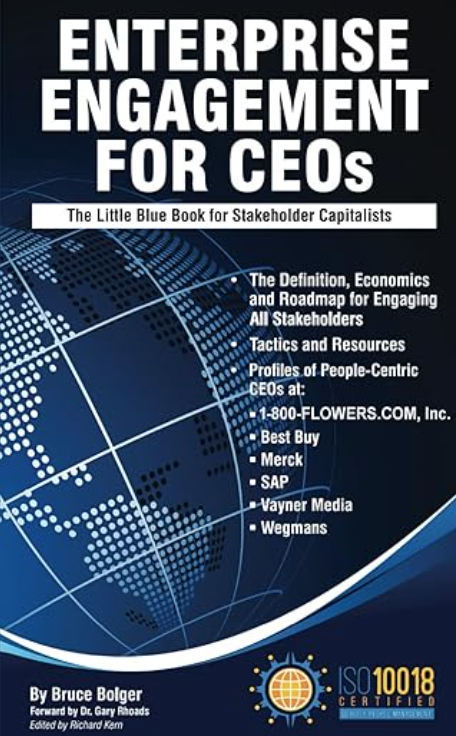
3. Books on implementation: Enterprise Engagement for CEOs and Enterprise Engagement: The Roadmap.
4. Advisory services and research: Strategic guidance, learning and certification on stakeholder management, measurement, metrics, and corporate sustainability reporting.
5. Permission-based targeted business development to identify and build relationships with the people most likely to buy.
6. Public speaking and meeting facilitation on stakeholder management. The world’s leading speakers on all aspects of stakeholder management across the enterprise.